Saturday, June 16, 2012

Race Report: Pocatello 50k

Distance:  35 miles
Time:  6:57:05
Place:  4


What a crazy race.  35 miles across some very tough terrain in tough conditions...bring it on, right?  Cody and I drove up to Pocatello on Friday night after work and made it to the 50 Mile starting area at Mink Creek just as the temperatures were starting to cool off and the sun was going down.  We set up Cody's tent (mostly because of the bugs) and both went to bed fairly early.  I actually slept exceptionally well, despite only using a couple of blankets for a sleeping pad, and woke up quite refreshed at around 5:30 after hearing Cody rummaging about getting ready for his race.  He was running the 50 miler, which started at 6 AM, while my race, the 50k (legs 2 and 3 of the 50M), wouldn't start until 8:30.  I lounged around drinking water and Powerade until I felt sick, because the weather report was calling for a scorcher.  After the start of the 50M I got dressed in my race clothes and ate some last minute snacks and got on the bus that would take me to the starting line.
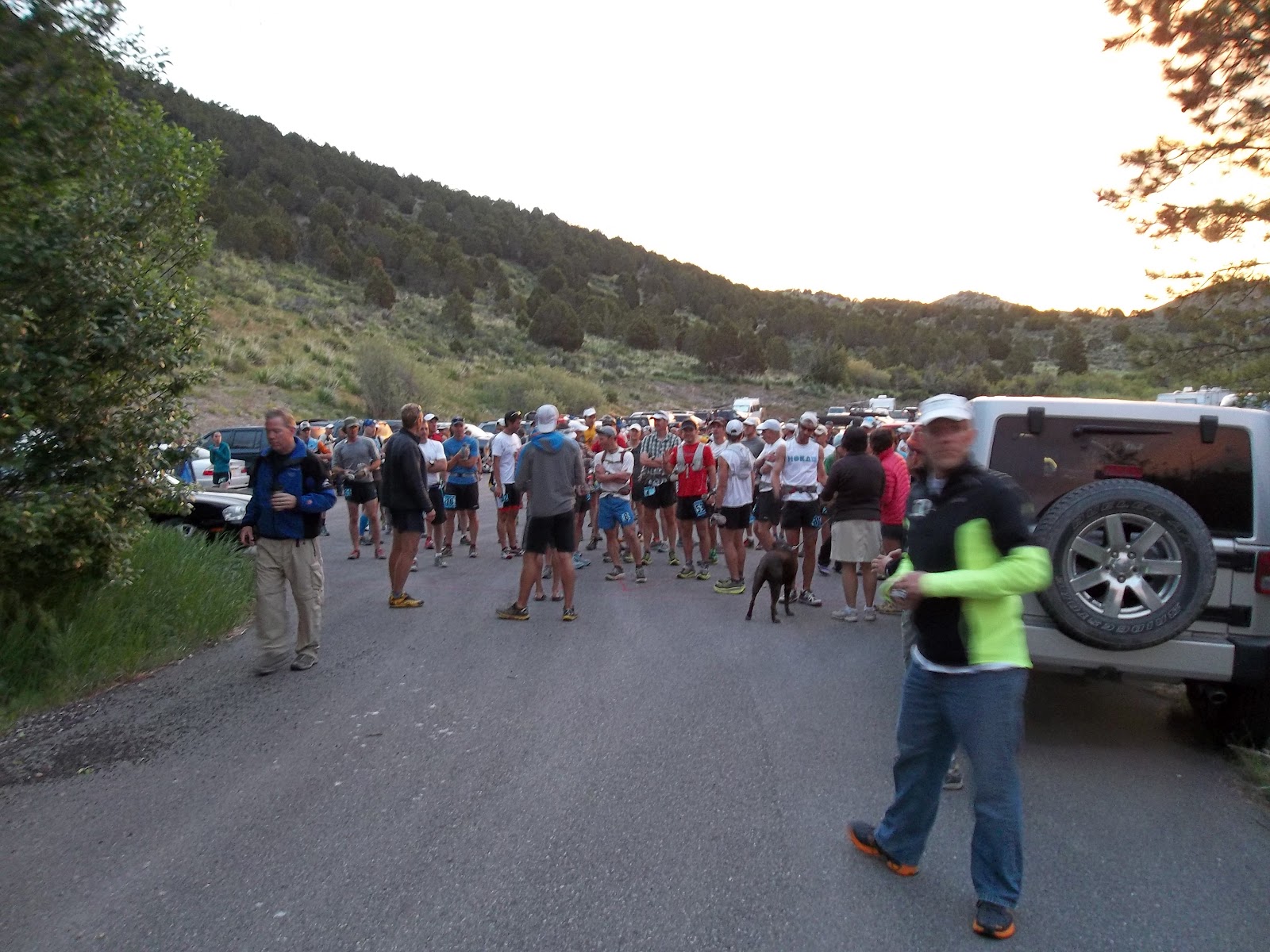
50 Mile Start
Once I got to the starting line I kept swigging water like a camel and consequently had to pee about 3 times in the half hour we were waiting for the race to start.  Unfortunately, I also discovered that my Garmin battery had somehow died, so I have no data on this run.  I chatted with Ty Draney and Luke for a minute before the race.  Soon, we lined up at Luke's makeshift starting line which he drew in the dirt with his foot.  Classic.  After the countdown, we were off.

Ty, myself, and two other guys quickly formed the lead pack and headed off at a brisk but manageable pace.  The lead guy seemed to be antsy, and he began putting distance on us right away.  The rest of us decided to let him go, knowing that there were still 30+ miles of racing ahead.  Turned out to be a good decision.  The first leg was 15 miles between the City Creek Trailhead and Mink Creek, the first half of which varied between a moderate and insane climb.  The first few miles flew by, as I'd run this part of the course before.  Presently, the other guy (Brian, I think) began to move ahead chasing the first guy who took off, but I decided that my best strategy would be to hang around Ty.  I correctly surmised that he would be the man to beat in this race.  We chatted off and on and got to know each other a little bit, although we were already somewhat acquainted.  Ty is a really cool guy...a great person to run with on some trail in the middle of nowhere.  After the first few miles of gradual climb, the trail became very steep and rocky, taking us up a narrow draw leading straight up the side of the mountain.  The overhanging scrub formed a sort of tunnel which was nice and shady.  I already knew that today was going to be very hot, because the temperature, while initially cool, was beginning to rise rather quickly.  Eventually, we exited the chute and began hiking up out of the ravine and soon crested the mountain onto a dirt road.  We could see the leader about 2 minutes ahead of us, and Brian about a minute ahead.  At this point, the course turned to a long, gradual downhill, and we began to open up the pace a bit and close the gap.  We soon caught Brian, and by the time we got to the first aid station we had nearly a minute on him.  We quickly filled our bottles and began hiking up another 600 foot climb.  The second guy made up some time here, as we were kind of dilly-dallying, saving our strength for the really tough parts ahead.  He hung with us as we reached the top of the climb and began the smooth and very gradual descent into Mink Creek Aid.  Somewhere along here, Ty peeled off into the bushes for a pit stop, and I decided that if I was going to get a chance to make a move, this would be it and likely my only one.  So, I flipped the knob to my best mile-eating pace without killing myself and tried to put some distance between me and Ty.  I quickly dropped Brian, and just cruised along enjoying the run.  About a mile or so out from the aid, I unexpectedly caught the lead guy.  I don't know if he was hurting or if I was just feeling really good going fast but I blew past him and he quickly dropped out of sight.  In the space of less than probably 3 miles I went from 4th to 1st with a nice lead.  I determined that my best strategy would be to hang on to the lead as long as possible, and to try and get out of range of Ty's insane downhill gear before the descent off of Scout Mountain, about 13 miles +/- ahead.  I'm no slouch of a downhill runner compared to most, but Ty is in a league of his own.  I pulled into the aid feeling great about how everything was going thus far.  The aid station personnel were great and had my drop bag ready for me so while they were filling my bottle I grabbed a couple of sleeves of Shot Bloks and another Nutri-Grain bar, as well as some potato chips.  I finished off by stuffing half a PB&J into my mouth.  I was loaded up for the long road over Scout Mountain.

Once out of Mink Creek aid, I began to really notice the heat of the day.  Until now, it had been morning time and the trail had been relatively shaded, but at this point the trail became more exposed to the already hot sun.  Water was going to be an issue, so I began to think that I should have brought two bottles.  Too late.  Soon I heard a sound behind me, and glancing over my shoulder I saw that I was being pursued by the guy I passed before Mink.  He looked to be feeling good and was obviously making up ground on me.  I tried to pick up the pace without redlining and began to put the distance back on him.  The heat and fatigue were beginning to tell on me, but I was still feeling decent and that's just part of the game.  By the time I reached the next aid station, I had put at least a minute back on him on a pretty tough grunt of a section.  Luke met me 3-4 minutes in front of the aid and gave me an update on the 50 mile race.  It was nice to have a little help and encouragement there, and he got some orange slices (note to self, orange slices are awesome) and S-caps ready for me.  I left the aid with renewed vigor and got ready for the tough climb up Scout Mountain.

The 50k consists of Legs 2 and 3 of the 50M.  Mink Creek Aid is at the bottom of the "V" between 2 and 3.


I had no idea how far back Ty was, and I wasn't too excited about anyone else catching me, so I decided that it was now or never to put the hammer down.  This section was really beastly.  Not a lot of runnable territory.  Lots of hiking.  But, here I discovered that I actually have an uphill gear.  I was figuring that Ty couldn't be more than a couple of minutes back, and that the other guy was probably somewhere closer (assuming Ty hadn't passed him--not a safe assumption), and I was also guessing that Brian was somewhere within 5 minutes of me.  At one point there were three random college age kids, one wearing a were-wolf suit.  Side story:  apparently there had been a Sasquatch sighting a couple of weeks before the race in the area--I'm guessing that had something to do with the wolf suit. They were hollering and screaming like a bunch of drunk Indians.  I waved as I powerhiked past them, chuckling to myself but glad of the support.  About a hundred yards past them I heard them yelling again, and got a bit of a scare, but it turned out to be a 20 mile runner.  He caught me and we chatted for a bit.  Nice guy.  He took off and I kept powerhiking.  This section was actually pretty empowering, because I discovered a new uphill ability.  I was moving really well...better than I ever remember on such a tough section.  Soon I got out of the trees and onto the more exposed mountainside.  There were switchbacks, and I thought I could make out Ty about 5 minutes behind, along with a few 20 milers between us.  I was really surprised that I'd been able to put that kind of distance on him uphill.  I came across one of the very few snow patches and filled my hat with it.  It started melting in my eyes and stinging really bad, so I switched the brim around to the back and that was really nice because it would drip water down my back--very nice.  The rest of the climb was pretty uneventful.  Got passed by a couple more 20 milers and didn't really care, saw some four-wheeler riders who thought we were crazy, filled my hat with snow again.  The views were great from the top of Scout.  This really is a very scenic course.  Finally I reached the summit, and a guy said it was 3 miles to the aid, all downhill.  He lied.  It had to have been at least 5.  It was definitely downhill though.  The first part of the descent is usually a glissade down a snowfield, but this year with the hot temperatures and lack of snow it was a downhill hike.  I was tired and not too excited for the steep drop, but I made it down to the more sensible and runnable section without falling on my face, so it was a success.  The fast descent started to mess with my breathing again, but I think I have discovered how to deal with it.  I noticed that I would not breathe as deeply as I needed to, but if I focused on it I could do better.  I also found that putting my hands on my head for a few steps helped to loosen up my diaphragm.  Somewhere in here I ran out of water.  Poor planning.  Couldn't eat without water, so I got no electrolytes, and no water for at least a mile.  Not good.  I paid a heavy price.

I FINALLY reached the final aid station at Big Fur (Fir?--who knows) after what seemed an eternity.  I was swearing under my breath at the jerk at the top who said it was only three miles.  Probably not too nice of me, but hopefully you'll cut me some slack.  Should have been more familiar with the course.  The aid did look like the pearly gates of heaven at this point.  I was thinking I had 7 miles to go, probably because the heat wasn't helping my math skills, but they said it was only 5.  I asked for water, orange slices, and S-caps.  I tore into a couple of orange slices and got a big glassful of water.  It was super cold and refreshing.  Unfortunately, I was too far gone on my electrolytes, and I didn't get 10 feet out of the aid before it all came back up.  Ty finally caught me at this point, with the lead 50 miler hot on his heels.  He got out of the aid before I finished losing my breakfast.  From here, things went downhill in a hurry.  Actually, they went uphill.  After a brief stint on the blazing hot asphalt road, and a couple of stops to puke up the water I was trying to drink, the course turned onto a dirt road/snowmobile trail, and climbed relentlessly uphill.  I had been expecting this, but I had also been expecting to be able to run more than 100 feet without stopping to puke my guts out.  My state continued to worsen, and I was reduced first to walking, then walking from one shade tree to the next and stopping to rest and throw up.  This continued for what felt like forever.  Got passed by lots of people, mostly 50 and 20 milers.  Saw Karl Meltzer come running past like he was out on an easy Saturday run, and he tried to get me moving as he ran past.  Surprisingly, there seemed to be no 50k runners passing me.  The second place guy had passed me at the turnoff onto the dirt, but no one in the hour or so since, so I was still somehow in third place.  Finally, when I had just over a mile to go, a guy caught me and knocked me back into fourth.  No big clay urn for me today.  But I didn't have anything in me to do anything about it.  Shortly after that, I stopped under a shade tree to try and bring my body temperature down.  I could just feel myself cooking to death, and I knew I was in trouble.  This was no longer a race for placing or fun, but a matter of survival.  I had water, but could not keep it down.  Dangerous.  Do not try this at home.  As I was lying there, some kindly 20 milers stopped and asked if I was ok.  I finally admitted that I wasn't and told them to let the people at the finish know that I was in bad shape, but that I was going to try and make it in anyway.  I was this [] close to DNF-ing in the last two miles of the race.  But, thankfully that was not to be.  Cody finally caught me and told me to get off my butt and run the last mile.  I didn't realize I was that close (remember, my Garmin was dead), so I got to my feet and began to shuffle forward again.  Another kind lady, Sherry I think was her name, bless her heart, gave me some encouragement and said she would run in with me, as we were going about the same speed.  She really kept me going and I finally found the ability to run under my own power again, thanks to an S-cap that finally started working.  The last mile was torturous, but I made it into the finish in one piece and very glad to be done with the hardest race of my life, and in 4th place despite the adversity.

The last five miles took me almost two hours to complete, but I still finished in just under 7 hours.  Not bad considering the extreme heat, my poor planning, and the resulting 5 mile death march.  Surprisingly, I was able to recover very quickly once I got some water to stay down and got cooled off in the shade.  There was some little kid at the water spigot who was taking great pride in spraying down grateful runners with a hose.  He asked if I wanted to be sprayed and I gladly accepted.  Heavenly.  Cody, however, did not fare so well.  I did a lot of my recovery on the course, but after he finished, his condition deteriorated rather than improved.  I got my appetite back and was enjoying a giant bowl of chili, provided after the race (Best. Chili. EVER.  Sorry Mom, I'm sure yours is just as good after running 35 miles) when Cody sat down next to me and it was immediately obvious that he was in a bad way.  He was white as a sheet, soaking wet, and shaking like a quaking aspen leaf on a windy day.  He couldn't eat, drink, or do much of anything besides shuffle over to the fire pit and try to throw up.  I was keeping an eye on him, wondering if he'd recover or if he would need help, when he asked me to go get Luke (the RD/"freaking doctor") to help.  Long story short, he ended up in the medical trailer with an IV in his arm hugging bags of ice.  Kind of comical, actually.  He was a new man after about an hour of that. Here's a photo of he and Ty being revived:

Note the barf bowl by Cody's leg.  Thankfully they didn't use it.
After this small but memorable adventure, we made our way back to Logan.  This race was a big success for me, even though the last part of it was extremely brutal.  I proved a lot to myself, and learned a lot of things that will help me be a better runner in the future.  Like bringing more than one bottle when there's going to be 10 miles between aid stations and the forecast says it's going to be 85 degrees and sunny.  Both Cody and I were very satisfied with our races.  He finished a whole hour ahead of what he thought he could do, and placed 7th against some VERY good competition in what is known to be one of the hardest, if not the hardest, 50 mile race in the country.  I finished 4th in my race, even taking almost two hours to go the last 5 miles, and I held my own against some very good runners, and I gave myself a good chance to win a very tough race.  Made a couple of new friends in the process and overall had a really good day.  Now, on to the next adventure!


Sunday, May 6, 2012

Race Report: Provo City Half Marathon

Distance:  13.1 miles
Time:  1:12:30 (5:32/mi.)
Place:  5

The Provo City Half Marathon is a relatively new race put on by the Run13 event company--I think it has only been around for a couple of years.  This year there was also a marathon option, as well as a 5k and relay option for the half.  I signed up for the race because I had a few weeks in a row with no race and so I decided it would be a good place to throw in a half to help prepare for the Top of Utah Marathon this fall.  It worked out nicely because this same weekend I was in between apartments and was going to go home for a few days until I could move into my new place, so I was already going to be going through Provo.  Additionally, my parents were in Salt Lake City this weekend for an autism conference and were able to share a hotel room in Provo with me and watch the race. While I was at the hotel, I ran into my old track coach from high school who was there with his team for the BYU Invitational.  It was really good to catch up with him for a few minutes.  Small world!

I had to get up at 4:30 AM to drive downtown and catch a bus to the start, which is up the South Fork of Provo Canyon at South Fork Canyon Park.  The final bus was leaving at 5:30 for a 7:00 AM start, which was kind of confusing to me.  But, I suppose better early than late.  My bus arrived at around 5:45 so I had over an hour to wait.  There were a couple of fires at the start to keep people warm but nowhere near enough for the several hundred participants.  So it was a long, chilly wait for the race to start, but luckily it has been a warm spring so temperatures were not too bad as long as you kept your outer clothes on and moved around.  I did get plenty of warming up in.  At about 6:45 I took off my outer layer and put my drop bag on the bus, after which they promptly announced that the half would no longer be starting at 7:00 AM, but would start at 7:15 after the full marathon start.  Would have been nice to know before I dropped my warm clothes.  But, I think the race is only in its second or third year, so the race directors are probably still trying to figure out how to deal with the growth so I can't fault them too much.

At the start line, there were a few fast looking guys.  Seth Wold was there, and I chatted with him for a minute about his Altra shoes, which I'm thinking of purchasing to try out.  After the usual pre-race soapbox by the RD, we got started.  The fast looking guys were indeed fast, and they all took off like there was a house on fire.  I decided not to try and run 4:50s to start so I let them go.  Two of those guys (Teren Jameson, Riley Cook) would go on to run 1:07 for the half, followed by Fritz Van de Camp in 1:08.  Smart of me not to go out with them.  Seth also went with them, but he was not planning on sticking with that pace the entire race so I thought maybe I would be able to catch him later.  I decided to run my own pace and shoot for around 1:12.  Unfortunately, I left my Garmin in my pack at the hotel, so I had no idea of my time, pace, or where I was on the course.  I planned to just rely on the mile markers and run by feel without worrying about what my time was and see how it panned out.  Unfortunately, there were no mile markers that I could see.  I did not see a single one until the 9 mile mark on University Ave.  After that they were visible, but I was confused that I hadn't seen any of the first 8 if there were any.  The aid stations didn't seem to correspond to the mile markers either (e.g. one every two miles) so it was no help to guess by that either.  But it turned out ok as I just ran by feel and enjoyed the race.

The first two miles(ish?) of the course were pretty downhill coming down South Fork, but not a total quad burner.  I was by myself after the first 100 meters when Seth and Co. left me, and there was no one behind me for a ways that I could see.  This was going to be a race against myself.  The marathon runners were out on the course ahead, so it served as good motivation to be constantly passing people, even if they were only going at 4-5 hour pace.  Many of them would cheer me on as well, which was enjoyable.

The Provo River Trail is a pretty gradual and even downhill all the way to the mouth of the canyon.  Perfect for opening up the stride but not steep enough to burn up the quads or calves.  You can hardly tell you're dropping most of the time.  This section was pretty uneventful.  I felt great and was enjoying watching the scenery fly by.  It had been a long time since I felt this relaxed and fast in a race.  Just before we exited the canyon, I saw Sasha Pachev (the mastermind of the Fast Running Blog) and some other guy out for a morning run.  I'm not sure he recognized me, but he definitley recognized the SGRC singlet.  I waved hi as I ran by going the other way.

Once out of the canyon, the course spit us out on University Avenue (or at least a road that turns into University).  This part of the course was as level as the plains of Kansas.  There was one hill to climb as the course turned south into the main part of Provo, but other than that it was perfectly smooth and flat.  I finally began seeing mile markers, and it was also fun to race cars that were slowed down due to the race.  Some of them had to be hating me because I was getting where I was going faster than they were.  I still felt great, although I was starting to feel a little tired.  There were a few people out on the course cheering me on, and there would be large groups at the aid stations.  The few miles I had left just flew by and before I knew it I was counting blocks instead of miles.  I finally saw the finish line ahead and could see Seth less than a minute ahead of me.  He was the first half marathoner I'd seen since I lost sight of the lead guys at the start of the River Trail.  I could make out 1:11 on the clock when he finished and I knew I could make my goal of 1:12.  I surged ahead trying to beat 1:12:30, but just tied it.

This race was really good for me.  It felt great to get out and run a good time and still feel good afterwards.  I went and got a massage but wasn't really sore at all.  I also ate some Magelby's french toast they had for us--great call by the RD.  I haven't felt this good after a race since Sand Hollow last year, or maybe since high school.  I went to watch the high school meet for a couple of hours I checked out of my hotel and was thinking "Man, I feel like I just ran a two mile and I could totally jump in and run the 800.  Put me in, Coach!"  Hopefully I can build on this race and have a great summer and finish strong in the fall at Top of Utah. 


Saturday, May 5, 2012

Race Report: Sand Hollow Marathon 2012

Distance: 26.2 miles
Time:  2:51:31
Place: 2 

Before I begin with this belated race report, I would like to take care of two items of business.
 
First, I would like to once again thank Jason and the volunteers and staff of the Sand Hollow Marathon for putting on another great race this year!  Once again it was a blast, and even with nearly three times the participation of last year's race, the volunteers, aid stations, post race food, course, and everything else was just superb.  I would recommend this race to anyone and everyone.
 
Second, I should apologize for the lack of posting.  I know everyone is SO interested in my blog.  :)  School has been very busy, and on top of that I got a new and better job and I am on the college robotics team, so needless to say between all of that stuff and trying to get back into racing shape, I've had little time for blogging.  Especially since when I blog I usually take forever and get very long winded.  But, summer is fast approaching so I expect to do more posting with the additional time I will have.
  
Anyway, on to the race report.


This year, I brought three of my friends who I will refer to in the running world as my "padawans" down to run the race. Their roommate came to watch as well, probably because she didn't want to be left kicking it at home alone all weekend.  It's a good race for beginners, despite the challenging nature of the course, because it doesn't beat you up as badly as some of our other Utah courses which tend to be drastically downhill.  Recovery is therefore a little easier.  Two of the three had run at least one other marathon, and the other would be making her first attempt.  We were all excited to take a trip down from the frozen northlands of Logan and spend the weekend in sunny Southern Utah...running.  What could be better?
 
We left Logan in plenty of time Friday to avoid a repeat of my experience at St. George last fall, and made it to Hurricane that afternoon without incident.  My parents had cooked up a big nice pasta dinner for us which we gorged ourselves on after going and picking up our packets at the golf course clubhouse near the turnaround of the course.  As a side note, my parents always like it when I bring girls down home to visit.  Probably because it gives them at least some hope that I'll someday find someone who will tolerate me and my obsession with running and get married.  Anyway, they were very happy to have the girls spend the weekend.  My youngest brother is going to be quite the ladies man, I think, because he got right in there and was curling their hair and being cute to beat the band. 

Saturday morning, we woke up around 6:30, which is pretty late for a marathon race day, but since I live 5 minutes' drive from the start and the race wasn't until 7:30, we got to get some beauty rest.  I ate some bread and a banana, and drank a bunch of electrolyte drink and water, since the forecast was calling for a very warm day.  We were also a little worried about wind, but in my experience with Hurricane weather I correctly surmised that, since it was supposed to be a southwest wind, it would not start until the afternoon.  After making sure all of our stuff was in order, we drove to the start.  I milled around a bit with some of the other runners and warmed up.  The temperatures were cool, but I could tell it was going to be a hot day.

Before.
(me, my padawans, and their very supportive roommate)

After a brief run through the usual race business, we got started.  I took off at the front, and was waiting to see if anyone would follow me, and if so, who.  I was hoping for a little more competition in this year's race, even though I was certainly not nearly as well prepared as I was last year due to my injury last winter.  I was quickly joined by Brian Summers of Sandy.  We exchanged hellos and I found that he was in a similar position as I was.  We were joined shortly by another runner from Boulder, CO named Aaron Hoover.  He seemed to also be a pretty experienced runner and we all chatted a little bit throughout the first few miles.  They were both wearing bright yellow singlets, so with me and my white SGRC singlet we looked pretty snazzy and hip in our lead pack trio, if I do say so myself.


After the first aid, Brian began to attack the pace more with some pretty big surges.  I knew I didn't want to be caught up in a sprint-and-then-try-to-survive race, so I tried to hold everyone back a little without falling behind Brian.  This worked pretty well, as Aaron might have realized that I knew the course very well and was probably doing it for a reason, so he seemed to stick with me and we kept things under control.  This continued until about the 10k mark where Brian began to fall behind a little bit when he wasn't pushing the pace hard, so I finally said that there was a long race still ahead, and that it was better on this course to keep calm and just let things happen.  This seemed to calm him a bit.  I didn't want the pack to break up at this point, as we were all still thinking about a possible headwind, and we were working quite well together keeping each other going strong.  We crested the big hill looking down into Sand Hollow and began the fast descent.  I opened up the throttle and let things fly, wanting to use the downhill for all it was worth, with Brian and Aaron following a short distance behind.


At the bottom, Brian came flying past but then faded very quickly, leaving myself and Aaron to our own devices.  We wouldn't see him again other than passing him going the other way on the turnaround.  I was still moving well and feeling surprisingly good.  We were on something between 2:35 and 2:40 pace at this point, so in very good shape time wise.  As a small side note, here is an example of why I love this race and the staff:  Coming through the aid at Mile 9, I missed all of the cups I tried to grab (my fault).  I wasn't too panicked, but within less than a quarter mile there was suddenly a car next to us with Jason, the race director, and his wife (I assume) offering us some water or Gatorade since I missed it.  I gladly accepted, knowing I that the hydration was going to be very important in this race.  Aaron commented that he'd never seen anything like that in any race, and that this was clearly a "5 star" race.  I heartily agreed.


The rest of the journey to the turnaround was pretty uneventful.  Aaron and I chatted a little and just enjoyed the run while keeping a solid effort.  On our way back, we both began feeling a little fatigue, but I was feeling better out of the two of us so around mile 15 I began to pull away a little bit.  I knew that "Nemesis" hill was coming up, so I wanted to push a little here and build up a little bit of a gap, which I was successful at doing.  The hill was very tough, but I made it up without walking and was relieved to finally get to the top and see some downhill.  Last year, this is where I really was able to put the hammer down and drop my time down with the long rolling downhill into Hurricane.  Unfortunately, I was not in nearly as good of shape this year, so after a brief period of attempting to replicate last year's strategy, I began to break down.  Mile 20 seemed like crossing a threshold from feeling relatively good (surprisingly good, actually) into a suffer-fest.  I knew I was not in prime racing shape, so I was almost expecting it, but it was still no fun.  However, before the race I had determined that I would just give it my best shot no matter what happened and be happy that I was able to run a marathon this early in the year despite my injury and the slow recovery.  I had built a huge gap on Aaron, but he managed to chip away at it little by little and he went past me around mile 23.  I had nothing left in the tank so I just let him go and concentrated on finishing as respectably as possible.  The heat was beginning to become a factor at this point, and I just wanted to be done with the race and somewhere cool with a cool drink of water.  At around mile 24 I suddenly got very sick and had to stop for a couple of minutes to deposit my breakfast in the weeds on the side of the road.  Again, the race crew was right there in a matter of probably less than a minute offering me water and making sure I was ok.  Can't say enough about how well run this race is.  I felt much better and was able to run the last mile feeling better and faster than I had for the past 5.

My finish time was 10 minutes slower than last year, at 2:51, but considering the unusual heat, and my lack of fitness I was satisfied with the results.  Aaron finished around 2:45, so I still own the course record, and hopefully that will go down next year when I break 2:40 on that course.  Brian must have had a very tough race because he finished about 10 minutes after I did...his only finish over three hours ever.  I think he was kind of bummed about it, but hopefully he'll be back next year.  It was actually nice to have a competitive race.  All in all another great Sand Hollow experience, and I plan on making it a regular part of my race schedule.


Friday, January 6, 2012

5 Keys to Marathon Training, Part 1: Miles


Please see the preview to this 5 part series on marathon training.

How much to run has always been one of the biggest debates among experts, non-experts, and everyone in between in the marathon world. On the one hand, you have what I will call the "Runner's World" philosophy—that running 3-4 days a week is sufficient for most people, and that anything more is crazy and/or unhealthy, and on the other you have the "1970s Old School Guys" philosophy which says that everyone should run 100+ miles per week like the Kenyans. I tend to avoid either extreme in this case, but in my experience I have found that a slight lean towards the Old School Guys is beneficial, and here's a short history lesson as to why:  In the 1970s and early 1980s, you had multiple American runners making waves in the world marathon scene. Guys ran 2:XX marathons in cotton tees, cutoff jeans, and Keds just for the heck of it, and that's not so much of a hyperbole as you might think. They quit their day jobs and worked part time at shoe stores just so they could log 100, 120, or even 140+ miles per week and run a sub-2:20.  Everyone ran, and ran a lot. Today, with the exception of the few Ryan Halls out there, American marathoning is somewhat in a funk. The median marathon finish time for both men and women has slowed by about 45 minutes in the 30 years since 1980, while most other demographics such as median age have remained surprisingly constant. We run in $100 shoes, and that's not counting the other nifty gear and supplements we all have, yet we are significantly (alarmingly, actually) slower than our recent predecessors. Meanwhile, the Kenyans and even European runners to some extent have taken the marathon by storm. Why? 

While there is still a debate about the causes, and many valid arguments, it is almost certain that part of the explanation lies in the increasing trend among American marathon runners to only run 3-4 days per week to merely survive a marathon, rather than shooting for the stars and working up to 40, 50, or even 60 miles per week so that one can actually enjoy race day and do something other than crawl across the finish line. Hundreds or thousands of training plans have cropped up which treat running as a dreadful ransom to be paid in order to check a marathon off one's bucket list, rather than treating it as the incredibly enjoyable (not to mention healthy!) pursuit that it can become to those who are willing to put forth the effort. We shop our training plans like we do our groceries—the lowest price wins, even if the product leaves something to be desired. Now, I'm not advocating that you give up your job and family and spend all day out running around in your Daisy Dukes and homemade Nike Waffles so you can log 140 miles per week. What I am suggesting is that if you want to enjoy race day and the days beyond, there is a price to be paid, but that price is totally and completely worth it, and it will change your life.  I subscribe enthusiastically to the following philosophy, as stated very well by professional marathoner Peter Gilmore (2:12:45, 2006 Boston Marathon):

“If the most common question I get asked is, “How do I run a fast marathon?”, the 2nd, 3rd, 4th, 5th... most common questions have something to do with diet, running form, sleep, footwear, stretching, weights; anything but actual running. American runners seem to have an unending fascination with all these extra-curricular activities, yet we continue to get slower at running marathons. It reminds me of the weekend cyclist who spends $5,000 for a new bike that weighs 3 ounces less, but he’s still got the pot belly under that colorful jersey.
So what’s my point?  If you want to improve your performance in the marathon, stop worrying about minimalist shoes, caveman diets, and new-age running form, and start worrying about getting out the door and running a little more than you did last week. High mileage works!  It is the single best method for the greatest percentage of runners to improve in the marathon.”

Now, obviously, there is more to marathon training than just running obscene amounts of mileage, and I think that Mr. Gilmore would also agree that there is more to the story.  But, as he stated, the best way to become a better runner is to, well, run more! And this is true for almost all runners, regardless of ability.  There is a reason that Part One of this series is about running a lot of miles. You can (and should!) read Gilmore's entire article here for more context and wisdom on the subject.

Now that we've established that, in order to run a marathon you need to run a lot, the question becomes “Exactly how much do I run?” That is the million dollar question, and is ultimately one which you must learn to answer for yourself, but here are some pointers to get you started.

Without exception, the most successful runners I know (meaning they enjoy it the most, as well as being very good at it), all run at least 6 days per week. Many (myself included) take a day off each week for religious reasons, others for recovery purposes, and some not at all, but they all run nearly every day or even multiple times per day. This sounds like a huge time commitment, and it can be for those nearing some kind of “really fast” status, but for a beginning marathoner, it is really not that bad. Besides, it's good for your health. You'll never worry about getting your 20 minutes of exercise 3 times a week if you're getting a half hour or an hour per day running with a couple of hours on weekends. It's also helpful to be able to establish a daily habit, and that habitual routine is essential for you to be consistent over the weeks and months leading up to race day, and consistency is absolutely imperative to a successful marathon.  There are physiological reasons to run daily as well, but I'll just boil it down to say that your body will adapt more quickly to running and your recovery time will drop if you run daily.  I firmly believe that everyone who really wants to can spend some time, 6 days per week, running--even if it's only for a few minutes because Tommy got sick, and there's a huge paper due tomorrow in school, and the world is ending in three weeks and you haven't finished your fallout shelter.  On those days, a few minutes of exercise will only help you anyway.

Alright, so you're going to run at least 6 days per week, but that still doesn't answer the big question of how far. How far depends largely on where you are starting from. Whether you are starting from ground zero, or if you've got some experience, don't be intimidated. The first thing you should know is that you absolutely can run for 26.2 miles, and fairly easily too, if you set your mind to it and start small.  A tune from an old Christmas movie comes to mind:

"Just put one foot in front of the other, and soon you'll be walking 'cross the floor.  Put one foot in front of the other, and soon you'll be running out the door!"  

The sooner you can begin, the better.  I've helped runners train who went from virtually no running at all to running a very respectable first time marathon in as little as 10-12 weeks, but that is the exception and is not something I would recommend to everyone. My first marathon came after 10 months of preparation. Generally speaking, the longer you have to train, the less likely you are to become injured from overtraining. Start with something small. Even one mile per day to start is a start. Your body needs time to get used to the new stresses of running, so don't become discouraged if it takes a few weeks. Age can also be a factor, as older people generally recover slower and need more time to adapt. The key to increasing your mileage so that you can reach that marathon mark is patience. Learn to listen to your body. There is such a thing as “good hurt” which is the general soreness you will feel as your muscles begin to learn how to run. There is also such a thing as “bad hurt” which can usually be pinpointed to a small, specific area, and which causes you to try and compensate your stride. If this happens, take a day off and run more slowly for the next few days.  I will talk more about injuries, and how to recognize, prevent, and treat them in Part 5 of this series. Take the first month or six weeks of running and gradually work up to 15-20 miles per week (about 2.5-3.5 miles per day, on average), as you feel able. By then, you should begin to feel more comfortable running, though it will still not be easy. If you already have some experience under your belt, you may already be comfortable at 20, 30, or even 40 miles per week.

Once you reach the point where you are beginning to feel comfortable, you can begin to ramp up your mileage in earnest. A good rule of thumb is to increase your mileage by no more than about 10% every other week.  So, if I ran about 50 miles last week, and the same this week, I can jump to about 55 miles next week.  If you already have some experience, especially very recently, there is some leeway here, but be careful not to overdo it. You are NOT in a hurry. Where you want to peak is up to you, but in reality the sky is the limit if you are patient enough. Your peak mileage is often determined by how much time you have to prepare. Most people can finish a marathon if they get to 40 miles per week if they have done the necessary long runs, etc, but if you can work up to 50 or 60 it will make worlds of difference. If you're really serious and have some significant running experience behind you, 70 mpw has, in my experience, proven itself to be somewhat of a magic number. It is at this point that I begin to feel “sharp” and ready to race. Many other marathoners I associate with tend to agree on that point. However, don't feel like you absolutely need to get to that magic 70 for your first marathon, especially if you have no prior running experience. Becoming a serious marathoner takes years of work, so don't expect to go conquer the world on your first try.  When you set your peak mileage goal, set a standard that you feel you can achieve, but one that will still challenge you.  Using that formula of ~10% increase every two weeks may prove useful.  Be sure to allow time to rest for a couple of weeks before race day.  You don't want to be running your peak mileage the week before your race.  More on tapering will be discussed in Part 3.   Many runners will also find that they need a recovery week every so often. Personally, I find that every 4-6 weeks it is beneficial for me to cut back on the intensity of my training, running my miles slower and with less urgency, but generally maintaining the volume.  If you find that you have set your goal a little too high, there is nothing wrong with re-evaluating it and adjusting it to fit the current circumstances.  We runners tend to be very stubborn people, and most of the time we get injured it's because we are doggedly clinging to some crazy arbitrary goal in which we bit off a little more than we could chew.  I've done this more times than I can count, so you're not alone.  There is no shame in adjusting your expectations to match your current abilities.  Indeed, this skill of learning to listen to your body and adjust accordingly is essential to success.

The next logical question is “How fast do I run these miles?” I will speak more of this in Part 2. There are some nuances to how to pace your training which are unique to the marathon, but I will discuss it more in depth and provide some helpful links on the subject in the next portion of this series. It is, however, an important question, so for now I will say that variation is key. This is true for all running, whether you are training for a marathon or a mile. Not all of your running should be the same length and the same pace, day in and day out. In fact, I think if it was you might go nuts. Some days should be easy, some hard, and some in between. Some days should be long, some days should be short, and some in between. You'll find it helpful to make a general plan of how far and how fast you plan to run each day of the week before you start the week, based upon how you felt last week, your goals, and your time constraints. The next post will deal mainly with the longer and harder days, but the rest of the days should be easy, and I've found much success interspersing easy days between hard days, to rest and recover. What is easy? Another good rule of thumb is that most of your running outside of specific hard workouts should be at what I call a “conversational pace.” In other words, it should be slow enough that if you were running with a partner that you could carry on a conversation quite easily. Contrary to what you might think, you will gain aerobic fitness just as well or better at a conversational pace as you will during a hard workout, so you might as well let your body rest as much as you can while doing it. Some people call these miles at a conversational pace “junk miles,” but in my opinion, as long as you are not overtraining, there is no such thing as a “junk mile.” I have never regretted a couple of extra easy miles when I felt good enough to do it without trouble.
So that is Part 1.  In summary, remember these points:

1) Don't be intimidated.  You CAN and WILL run this far! 
2) You don't need to run 100 miles per week, or anything close really, but the more you can run without overtraining, the better off you'll be, and the more fun you'll have on race day!
3) Take it easy.  Increase your mileage at a rate your body can handle.  Remember the general rule of ~10% every two weeks.
4)  Set a goal based on how much time you have available to train, but don't be afraid to adjust it as you learn how to listen to your body.
5) Take it easy.  Run most of your miles at a conversational pace.  Talking to yourself works, and gives you priceless looks on the faces of passers-by.

5 Keys to Marathon Training: Preview


'Tis the season to sign up for those summer and fall races, and as is usual at this time of year, I've been getting a lot of questions from friends and acquaintances who are beginning training for their first marathon, or who just want to improve their training for their next big race. In light of this, I've decided to write a series of posts on what I consider to be 5 essential keys to training successfully for a marathon. As a warmup, I will tell you what this series is not, and what it is.

What this is not:
  1. This is not a training plan. There are many training plans and philosophies out there that are available for your perusal and use. Some are good. Some are not. I will not endorse or condemn any one training plan. Those who are familiar with some of the finer nuances of marathon training lore will recognize some heavy influences from Tinman's philosophy, but my philosophy towards marathon training and running in general combines many ideas from multiple sources and from my own experience.
  2. This is not an exhaustive list of all factors and methods that influence or improve marathon training and running performance. Runners are like snowflakes in that no two are exactly alike, so naturally no two runners should train exactly alike. Age, fitness, experience, health, genetics, work ethic, and yes, talent, all have an important part to play in what each runner can do and how he or she should approach training. The items mentioned here are merely what I have found to work for myself, those who have mentored me in my own quest for excellence, and for runners I have helped learn how to train in one capacity or another.
  3. This is not a scientific discussion by an expert in exercise science, nor is it the work of an elite marathoner, but I will refer to the ideas of some scientific experts and elites, as well as the advice I have received from some very accomplished runners (including multiple Olympic Trials qualifiers, seasoned ultramarathoners, track athletes, and everything in between) I have had the pleasure to be acquainted with over the years.

What this is:
  1. As I stated before, this series is not a training plan. Rather, my goal in writing these ideas is to help runners who are new to the marathon, or even more experienced runners looking for more guidance or a fresh approach, to learn how to train themselves. Since I began running marathons nearly 5 years ago, I have had many people who have helped me to become independent in my running. By this I mean that I don't have to rely on a training plan someone wrote for me, and I have learned to listen to my body and experiment and find the things that work best for me. I am certainly still a work in progress, and I still ask advice and seek out information from those more knowledgeable than myself, but I am better able to train to my abilities because of the help I have received, so this is my way of paying it forward.
  2. The five keys I have listed here are the major things I have found which influence my performance and training the most, and which are within my control.  Again, this is not an all-inclusive list.  Take what you find useful, incorporate it into your training, and leave the rest for someone else.

I will post this series in 5 parts. They are as follows:

Marathon Specific Training
Pre-Race Taper
Nutrition
Rest, Recovery, and the Prevention and Treatment of Injuries

Additionally, if you wish to share more insights, experiences, anecdotes, agreement, or disagreement, please feel more than free to leave a comment.  In fact, I encourage it.  The more information and experience that can be collected here, the more helpful it will be to someone looking for guidance.
I hope you will find this helpful, and I wish you success. Happy Running!